From Shipment Chaos to a Trade Compliance MVP in Two Weeks
Some product ideas arrive as a feature request. Others arrive as a business risk.
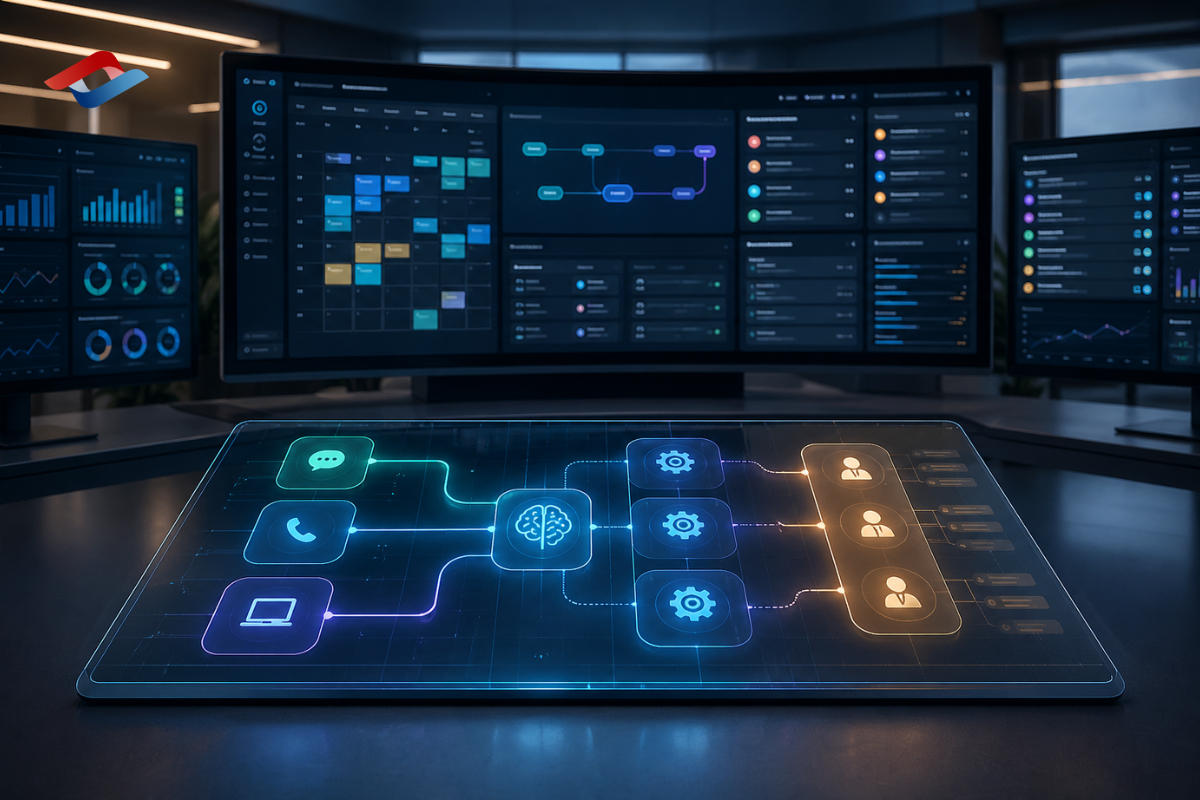
This one started with a logistics and import business that was moving faster than its internal compliance process could handle. The company dealt with suppliers across multiple countries, changing tariff rules, customs documentation, shipment delays, and customer questions about landed cost.
The team had experienced people, but their knowledge lived across emails, PDFs, spreadsheets, ERP notes, and individual memory. Every new shipment triggered the same chain of work:
The customer asked us:
"Can we build a copilot that reads our shipment documents, flags risk, and helps our team make faster compliance decisions?"
That question became the seed for a product: an AI-assisted trade compliance MVP for shipment documentation, classification support, landed-cost estimation, and audit-ready decision tracking.
It was timely, believable, and valuable because global trade teams are under pressure. Tariffs change, suppliers shift, customers expect faster quotes, and compliance mistakes are expensive.
The question was not only what to build. It was how to build the first usable version fast enough for the business to feel momentum.
Our answer was an AI-native two-week delivery model. We used ChatGPT and Gemini to synthesize discovery, Figma AI and Claude Design to move from rough workflow to usable screens, Linear AI to convert scope into a clear sprint plan, Codex and Claude Code to accelerate production engineering, v0 and Lovable to explore interface options, Replit to test small technical ideas, and OpenClaw-style multi-agent workflows to run implementation, review, testing, and documentation in parallel.
The result was not a futuristic promise. It was a practical build process designed for speed with control.
The Customer Idea
The original idea sounded simple: upload shipment documents and get answers. But during discovery, we learned that the real product was not a document Q&A tool. The real need was a decision support system.
The customer did not want AI to replace their compliance team. They wanted a product that could:
"Build a compliance copilot that turns unstructured shipment paperwork into structured, reviewable, and traceable decisions."
That framing made the MVP much stronger.
Week 1: Turning Vision Into an MVP Scope
We began with a requirement capture process designed around real documents and real decisions.
The tools and methods included:
Stakeholder interviews
With operations, finance, compliance, and sales teams.
FigJam
To map the shipment lifecycle from supplier quote to customs clearance.
ChatGPT and Gemini
To summarize interviews, compare stakeholder priorities, and identify repeated decision patterns.
Notion
To maintain the decision log, assumptions, and MVP scope.
Figma AI and Claude Design
To prototype the review console, document workspace, and approval flow.
Linear AI
To convert approved scope into epics, tasks, owners, and acceptance criteria.
Sample documents
Invoices, packing lists, certificates, and freight quotes to test extraction quality.
Rules matrix
In spreadsheet form to model duty rates, product categories, exception rules, and approval thresholds.
The key discovery was that users did not need a magic answer. They needed confidence.
So we designed every AI output to answer three questions:
The Discovery
What did the system find?
The Context
Why does it think this matters?
The Action
What should the human reviewer do next?
This principle shaped the whole product.
By the end of the requirement phase, we had a focused product definition: not "AI that answers trade questions," but a review workspace where AI prepares evidence and humans approve decisions.
Architecting a Copilot With Accountability
A trade compliance system cannot be built as a black box. Every recommendation needs traceability. We designed the architecture around six major capabilities:
Document ingestion
Users could upload commercial invoices, packing lists, bills of lading, certificates of origin, and supplier quotes. The system stored originals and extracted structured data.
Data extraction and normalization
OCR and document parsing converted PDFs and scanned files into normalized shipment fields such as supplier, product description, quantity, origin country, unit value, and shipment weight.
Knowledge retrieval
Internal product records, past classifications, supplier history, and policy notes were indexed so the copilot could retrieve relevant context before making a recommendation.
Rules engine
Duty rates, tax assumptions, approval thresholds, risk flags, and country-specific checks were handled through explicit business rules.
AI recommendation layer
LLMs summarized documents, suggested classification candidates, explained inconsistencies, and generated reviewer-ready notes.
Audit and review layer
Every recommendation required approval, rejection, or revision by a human reviewer. The final decision was stored with source references.
The technology choices were practical:
"The architecture deliberately separated rules, retrieval, and AI reasoning. That made the product easier to test, easier to explain, and safer to evolve."
Week 2: Building Around the Reviewer's Workflow
The first product screen we designed was not a dashboard. It was the review workspace. That was where the real decision happened.
The reviewer needed to see:
The interface had to be dense but not confusing. Compliance teams do not want a beautiful screen that hides detail. They want a workspace that helps them move faster without losing evidence.
To move fast, we used design and engineering tools in parallel:
v0 and Lovable
Helped us quickly explore document workspace layouts, review panels, and approval screens.
Figma AI and Claude Design
Helped refine the selected direction into a usable product flow.
Codex
Worked inside the codebase to accelerate frontend implementation, API wiring, refactoring, and test fixes.
Claude Code
Helped with backend services, document-processing flows, and edge-case review.
ChatGPT and Gemini
Helped create realistic shipment examples, reviewer scenarios, and documentation drafts.
Replit
Helped validate small parsing and calculation experiments before they were absorbed into the main architecture.
Linear AI
Kept the sprint plan up to date as the customer made decisions during walkthroughs.
OpenClaw-style multi-agent workflows
Allowed engineering, QA, documentation, and review tasks to move at the same time instead of waiting in sequence.
Focused MVP Modules
"We also built evaluation sets using historical shipment examples. For every test case, we checked whether the system extracted the right fields, identified missing information, retrieved similar records, and generated a useful reviewer summary."
This was not an uncontrolled AI build. Every tool had a job. Every output was checked by the team. Every risky workflow had human approval in the product.
This is where AGSFT Digital's AI-native development approach mattered. AI helped accelerate code generation, test coverage, data mapping, and interface iteration. But every workflow decision was reviewed by engineers and validated against business rules.
"Fast delivery only matters if the final product can be trusted."
The Two-Week Delivery Rhythm
The delivery was structured, visible, and fast:
Discovery & Scope Freeze
Stakeholder interviews, document review, AI-assisted discovery synthesis, workflow map, and MVP boundary.
Visualization & Logic
Figma flows, Claude Design exploration, v0 and Lovable UI options, architecture plan, and Linear backlog.
AI-Native Build
Parallel engineering with Codex, Claude Code, and human-led implementation across document upload, extraction, review, rules, and approvals.
Hardening & Review
Scenario testing, reviewer walkthroughs, Playwright flows, calculation checks, and AI-output evaluation.
Launch & Handover
Production hardening, monitoring, deployment, audit-trail export, documentation, and handover.
This is how a complex business idea becomes a usable MVP in two weeks. The process compresses weeks of analysis, design, development, and QA into a coordinated sprint without pretending that AI replaces product judgment.
Delivery: What the MVP Included
The delivered MVP included:
The product did not try to automate the entire compliance department. It focused on making the review process faster, clearer, and easier to defend.
That made the MVP immediately useful.
The Business Impact
The customer could now move from scattered document review to a structured decision workflow.
The real outcome was operational clarity.
Sales teams could get landed-cost estimates faster. Operations could identify missing paperwork earlier. Compliance leads could review the system's recommendation instead of starting from zero every time. Management gained visibility into shipment risk, review status, and recurring supplier issues.
Most importantly, the business gained a repeatable process. That is what turns an AI experiment into a product asset.
What This Story Says About AGSFT Digital
Many businesses already have the ingredients for valuable AI products: documents, workflows, experts, rules, and recurring decisions. The challenge is turning those ingredients into a system people can trust.
AGSFT Digital helps customers do exactly that. Our process is built around:
Understanding the business workflow before choosing the technology.
Using ChatGPT, Gemini, and structured workshops to translate vague ideas into a focused MVP scope.
Using Figma AI, Claude Design, v0, and Lovable to move quickly from concept to clickable product direction.
Using Linear AI to keep sprint execution clear and visible.
Using Codex, Claude Code, Replit, and OpenClaw-style multi-agent workflows to accelerate development without losing engineering control.
Designing architecture that supports scale, security, and accountability.
Delivering production-ready software with monitoring, testing, and documentation.
In this product story, the customer did not need "AI for trade." They needed better decisions, faster review cycles, and a system that could grow with their business.
Closing Thought
The next wave of business software will not be generic chatbots attached to existing systems.
The Vision
It will be workflow-specific copilots that understand documents, respect business rules, involve humans at the right moments, and create measurable operational advantage.
That is the kind of product AGSFT Digital is built to deliver: a believable, useful MVP in two weeks, powered by the right AI tools and guided by experienced product engineers.